


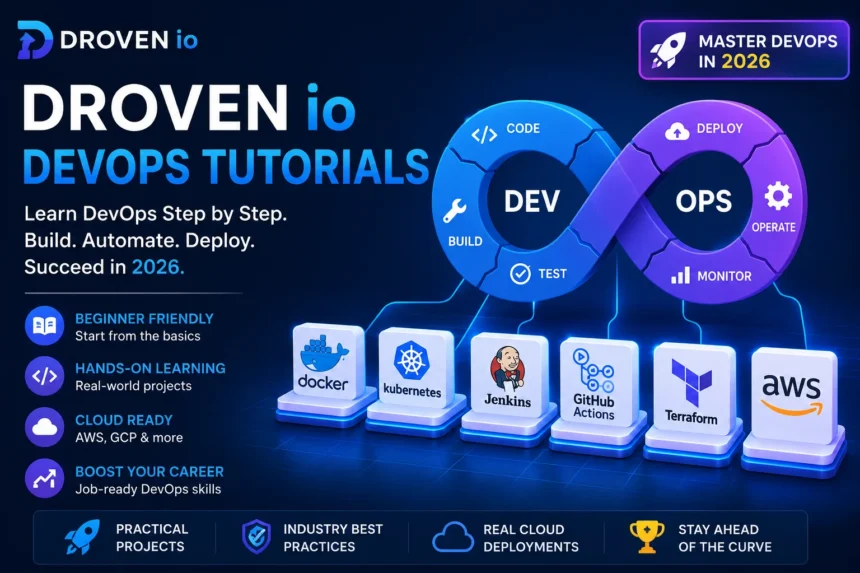
In today’s fast-changing technology world, companies need faster, safer, and more reliable ways to build and deliver software. This is where DevOps becomes important. Droven.io DevOps tutorials are focused on helping learners understand the concepts, tools, and practices used in modern DevOps environments. These tutorials can be useful for beginners, developers, system administrators, and anyone who wants to understand how software development and IT operations work together.
DevOps is not only about learning tools. It is a complete approach that combines people, processes, and technology to improve software delivery. Instead of developers and operations teams working separately, DevOps encourages teamwork, automation, continuous improvement, and faster problem-solving. Through well-structured learning resources like Droven.io DevOps tutorials, users can gradually understand complex topics and develop practical skills needed in real-world technology environments.
| Topic | Details |
|---|---|
| Main Focus | Learning DevOps concepts, tools, and workflows |
| Suitable For | Beginners, developers, IT professionals, and students |
| Main Skills | Automation, cloud computing, CI/CD, containers, deployment |
| Learning Style | Step-by-step tutorials and practical understanding |
Learning DevOps can seem difficult at first because it includes many different areas such as programming, cloud platforms, networking, automation, and system management. Many beginners feel overwhelmed because there are so many technologies involved. However, a structured learning path makes the process easier by breaking large concepts into smaller and understandable sections.
A good DevOps tutorial does not simply explain definitions. It helps learners understand why certain technologies are used and how they solve real business problems. For example, instead of only explaining what a CI/CD pipeline is, a useful tutorial explains how companies use automation to test and release applications faster while reducing mistakes.
Why DevOps Skills Are Important in Today’s Technology World
DevOps has become one of the most valuable skills in the technology industry because businesses depend on software more than ever before. From online shopping platforms to banking applications and cloud-based services, companies need reliable systems that can handle millions of users. DevOps practices help organizations create, update, and maintain these systems more efficiently.
Before DevOps became popular, software development and IT operations often worked as separate teams. Developers created applications, while operations teams managed servers and deployments. This separation sometimes caused delays, communication problems, and deployment failures. DevOps introduced a culture where both teams work together throughout the entire software lifecycle.
Modern companies use DevOps because it provides several important benefits:
- Faster software releases
- Better teamwork between technical teams
- Reduced manual work through automation
- Improved system reliability
- Faster identification and fixing of problems
For example, a company releasing a mobile application may need to update its software frequently. Without DevOps practices, every update could require many manual steps and create opportunities for errors. With automation tools and DevOps workflows, companies can test and deploy changes more quickly and confidently.
| Area | Information |
|---|---|
| Industry Demand | Growing need for DevOps engineers worldwide |
| Common Roles | DevOps engineer, cloud engineer, automation specialist |
| Important Skills | Linux, cloud, scripting, CI/CD, containers |
| Career Benefit | Strong opportunities in software and IT industries |
Another reason people are interested in Droven.io DevOps tutorials and similar learning resources is the increasing demand for professionals who understand both development and infrastructure. Companies are looking for people who can automate processes, manage cloud environments, and improve application performance.
DevOps knowledge is valuable even for people who are not planning to become full-time DevOps engineers. Software developers, cybersecurity professionals, data engineers, and IT specialists can all benefit from understanding DevOps because modern technology roles increasingly overlap.
What Topics Do Droven.io DevOps Tutorials Cover?
Droven.io DevOps tutorials cover many important areas that help learners understand how modern software systems are created, deployed, and managed. DevOps is a broad field, so learning usually starts with basic concepts before moving toward advanced technologies.
One of the first areas learners explore is the foundation of DevOps. This includes understanding the relationship between development and operations, why automation matters, and how companies use DevOps culture to improve their workflows. These basic concepts create a strong foundation before moving into technical tools.
DevOps learning often includes topics such as:
- Continuous Integration and Continuous Deployment (CI/CD)
- Cloud computing
- Docker and containers
- Kubernetes
- Infrastructure as Code
- Monitoring and logging
- Automation tools
- Version control systems
Each topic plays an important role in the DevOps ecosystem. For example, version control helps teams manage code changes, while automation tools reduce repetitive tasks. Cloud platforms allow companies to create flexible infrastructure, and monitoring tools help maintain system performance.
Droven.io DevOps Tutorials and CI/CD Pipeline Learning
CI/CD is one of the most important concepts covered in modern DevOps education. Continuous Integration allows developers to regularly combine code changes and test them automatically. Continuous Delivery and Continuous Deployment help teams release software updates faster and more safely.
A CI/CD pipeline works like an automated pathway that moves software from development to production. Instead of manually checking every update, automated systems can test code, identify problems, and prepare applications for release.
For beginners, understanding CI/CD helps explain how large technology companies can release updates frequently without disrupting users. Learning this concept through Droven.io DevOps tutorials can help students understand the practical workflow behind modern software delivery.
Docker and Containerization in Droven.io DevOps Tutorials
One of the most important topics learners discover through Droven.io DevOps tutorials is containerization, especially Docker. Containers have changed the way developers build and deploy applications because they allow software to run consistently across different environments. Before containers became popular, developers often faced problems where an application worked perfectly on their computer but failed when moved to another system.
Docker solves this problem by packaging an application together with all the required files, libraries, and settings needed for it to run. This creates a consistent environment where developers and operations teams can work together more easily. In DevOps, this consistency is extremely important because it reduces deployment errors and saves time.
For example, imagine a company building an online shopping application. Developers may create the application on their own computers, but the production server may have different configurations. Without containers, small differences between environments can cause unexpected issues. Docker creates a standard package that behaves the same everywhere.
Some important Docker concepts that beginners usually learn include:
- Containers: Lightweight environments that run applications independently.
- Images: Templates used to create containers.
- Dockerfile: A file containing instructions for building a Docker image.
- Container Registry: A place where Docker images can be stored and shared.
Learning Docker through Droven.io DevOps tutorials helps beginners understand how modern applications are packaged, tested, and deployed. Docker is now widely used in cloud environments because it makes applications easier to manage and scale.
Why Docker Skills Matter in DevOps
Docker is not just a development tool; it is an important part of the complete DevOps workflow. It connects software development with deployment by making applications easier to move between different stages.
A typical DevOps workflow may look like this:
- Developers write application code.
- The code is stored using version control.
- Automated systems test the application.
- Docker packages the application.
- The application is deployed to servers or cloud platforms.
This process improves speed and reliability because teams spend less time fixing environment problems and more time improving software.
For beginners, Docker can feel technical at first. However, with step-by-step learning and practical examples, it becomes much easier to understand. A strong foundation in Docker also prepares learners for more advanced DevOps technologies like Kubernetes.
Kubernetes and Cloud DevOps Tutorials: Managing Modern Applications
As applications grow larger, companies need better ways to manage thousands of containers. This is where Kubernetes becomes important. Droven.io DevOps tutorials often include concepts related to container management because Kubernetes has become one of the most popular technologies in modern DevOps environments.
Kubernetes is a container orchestration platform that helps organizations automatically manage, scale, and maintain container-based applications. Instead of manually starting and stopping containers, Kubernetes can handle many tasks automatically.
For example, if a website suddenly receives millions of visitors, Kubernetes can help increase application resources to handle the additional traffic. When demand decreases, it can reduce resources to save costs.
Some important Kubernetes concepts include:
- Managing container workloads
- Automatic scaling
- Service management
- Application availability
- Updating applications without downtime
Understanding Kubernetes gives learners a better view of how large companies operate their technology systems. Many organizations use Kubernetes because it provides flexibility, reliability, and automation.
Understanding Cloud Computing in DevOps Learning
Cloud computing is another major part of modern DevOps. Platforms such as cloud infrastructure services allow businesses to create and manage servers, storage, and applications without maintaining physical hardware.
Cloud DevOps combines cloud technology with automation practices. This allows companies to deploy applications faster and manage infrastructure more efficiently.
| Cloud DevOps Area | Purpose |
|---|---|
| Virtual Machines | Running applications on cloud servers |
| Cloud Storage | Saving and managing data |
| Networking | Connecting applications and services |
| Security | Protecting cloud environments |
| Automation | Reducing manual infrastructure tasks |
Through Droven.io DevOps tutorials, learners can understand how cloud technologies support modern software development. Cloud skills are especially valuable because many businesses are moving their applications from traditional servers to flexible cloud environments.
Infrastructure as Code in Droven.io DevOps Tutorials
Infrastructure as Code (IaC) is another important concept covered in many DevOps learning paths. It allows teams to manage infrastructure using code instead of manually configuring servers and systems.
In traditional environments, an IT professional might spend hours manually setting up servers. This process can be slow and mistakes can easily happen. With Infrastructure as Code, teams can create automated instructions that build and configure infrastructure consistently.
This approach brings several advantages:
- Faster infrastructure setup
- Fewer configuration mistakes
- Easier collaboration
- Better tracking of changes
- More reliable environments
For example, a company launching a new application may need databases, servers, security settings, and networking configurations. Instead of creating everything manually, IaC tools can automatically build the required environment.
Learning Infrastructure as Code helps DevOps professionals think about infrastructure in a more organized and automated way.
How Infrastructure Automation Improves DevOps Workflows
Automation is one of the main principles behind DevOps. The goal is to remove repetitive manual tasks and allow teams to focus on improving applications.
A common DevOps automation process may include:
- Automatically creating servers
- Installing required software
- Deploying applications
- Running security checks
- Monitoring system performance
This improves efficiency because teams can repeat the same process many times with consistent results.
For beginners, understanding automation is one of the biggest steps toward becoming comfortable with DevOps. It changes the way people think about technology by focusing on creating systems that can manage tasks automatically.
How Droven.io DevOps Tutorials Help Beginners Learn DevOps Step by Step
Learning DevOps can feel challenging because it combines many different technical areas. Beginners often wonder where they should start and which skills they should learn first. A structured approach makes the learning process much easier.
Droven.io DevOps tutorials can help learners understand concepts gradually by moving from basic topics to more advanced technologies. Instead of trying to learn everything at once, beginners can build knowledge step by step.
| Learning Stage | Skills to Focus On |
|---|---|
| Beginner Level | Linux, networking basics, Git, programming basics |
| Intermediate Level | Docker, CI/CD, cloud platforms, automation |
| Advanced Level | Kubernetes, security, infrastructure management |
The first step is understanding the fundamentals. Beginners should learn how operating systems work, how networks communicate, and how applications are developed. These basics make advanced DevOps concepts much easier.
After learning the foundation, students can move toward practical tools. For example, learning Git helps with code management, while Docker introduces modern application deployment methods.
Practical Skills You Can Gain From Droven.io DevOps Tutorials
The biggest advantage of DevOps learning is developing practical skills that can be applied in real projects. Instead of only understanding theories, learners can build experience with technologies used by professional teams.
Some important skills include:
- Managing application deployments
- Creating automated workflows
- Working with cloud environments
- Monitoring application performance
- Understanding server management
- Improving software reliability
A beginner who practices these skills regularly can gradually become comfortable working with real-world technology systems.
Common Challenges Beginners Face While Learning DevOps
Many new learners struggle with DevOps because it covers a wide range of topics. Someone may understand programming but struggle with servers, while another person may understand infrastructure but need more coding knowledge.
| Challenge | Solution |
|---|---|
| Too many technologies | Learn one concept at a time |
| Difficulty understanding infrastructure | Practice with small projects |
| Lack of real experience | Build personal DevOps projects |
| Confusing technical terms | Focus on practical examples |
The key to learning DevOps is consistency. Instead of trying to master every tool quickly, learners should focus on understanding the purpose behind each technology.
Frequently Asked Questions About Droven.io DevOps Tutorials
1. What are Droven.io DevOps tutorials?
Droven.io DevOps tutorials are learning resources designed to help users understand DevOps concepts, tools, and workflows. They may cover topics such as automation, cloud computing, CI/CD, containers, and infrastructure management for beginners and professionals.
2. Are Droven.io DevOps tutorials good for beginners?
Yes, DevOps tutorials can be useful for beginners because they explain complex concepts step by step. Beginners can start with basic topics like Linux, networking, and Git before moving toward advanced tools.
3. What skills can I learn from Droven.io DevOps tutorials?
Learners can develop skills related to automation, cloud computing, deployment pipelines, Docker, Kubernetes, monitoring, and infrastructure management. These skills are valuable in modern software and IT careers.
4. How long does it take to learn DevOps?
The learning time depends on a person’s background and practice routine. Beginners may need several months to understand the basics, while becoming highly skilled requires continuous learning and real project experience.
5. Is DevOps a good career choice?
DevOps is considered a strong career field because companies increasingly need professionals who can automate processes, manage cloud systems, and improve software delivery. It offers opportunities across many technology industries.
Final Thoughts on Droven.io DevOps Tutorials and Learning DevOps
DevOps has become an essential part of modern software development because businesses need faster, safer, and more reliable technology solutions. Learning DevOps requires patience because it combines many different skills, but a structured approach can make the journey much easier.
Droven.io DevOps tutorials represent the type of guided learning resources that can help beginners understand important concepts such as automation, cloud computing, CI/CD pipelines, Docker, Kubernetes, and infrastructure management.
The most effective way to learn DevOps is not only by watching tutorials but also by practicing. Building small projects, experimenting with tools, and solving real problems help turn theoretical knowledge into practical skills.
As technology continues to evolve, DevOps skills will remain valuable for developers, IT professionals, and anyone interested in building a career in the modern digital world.
Read more :Droven.io Best AI Jobs in USA: Top AI Careers and Future Opportunities