


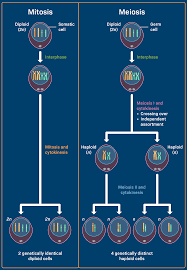
Mitosis builds, repairs, and replaces body cells.
Meiosis creates reproductive cells and reshuffles genetic information.
Understanding their differences makes chromosome biology much easier.
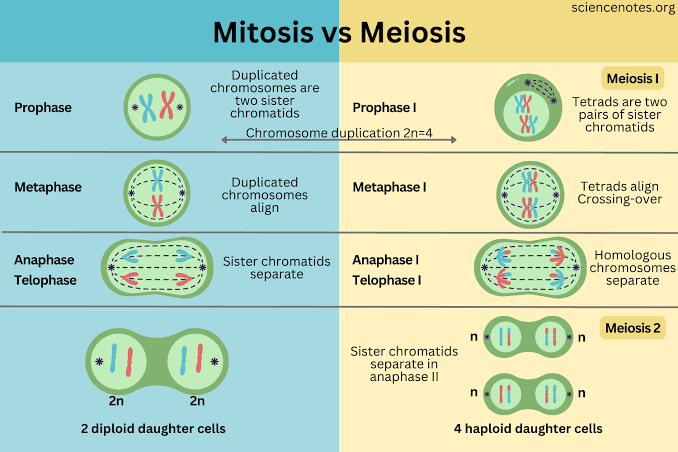
At a Glance
| Feature | Mitosis | Meiosis |
|---|---|---|
| Main role | Growth and cell repair | Sexual reproduction |
| Nuclear divisions | One | Two |
| DNA replication | Once before division | Once before both divisions |
| Final cells | Usually 2 | Usually 4 |
| Chromosome number | Usually maintained | Reduced by half |
| Genetic similarity | Usually genetically identical | Genetically different |
| Homologous pairing | No | Yes, in meiosis I |
| Crossing over | No | Yes, during prophase I |
| Main division | One complete division | Meiosis I and II |
| Genetic variation | Limited | Strongly increased |
These differences explain why the two processes have different jobs.
What Is Mitosis?
Mitosis is a nuclear division process.
It produces new cells for growth and tissue maintenance.
The chromosome number usually stays unchanged after division.
Before mitosis, the cell copies its DNA.
The duplicated chromosomes then separate during one division.
This produces two daughter nuclei.
In many animals, body cells are diploid.
Therefore, mitosis usually produces two diploid cells.
The daughter cells closely match the parent cell genetically.
A simple example is skin repair.
Damaged skin needs replacement cells.
Mitosis helps create those replacement cells.
Mitosis Has One Major Division
The process follows familiar chromosome stages:
- Prophase: Chromosomes condense.
- Metaphase: Chromosomes align near the cell center.
- Anaphase: Sister chromatids separate.
- Telophase: New nuclei form.
- Cytokinesis: The cell divides physically.
The key point is simple.
One division produces two similar daughter cells.
What Is Meiosis?
Meiosis is specialized cell division.
It supports sexual reproduction in many eukaryotic organisms.
Its biggest job is reducing chromosome number.
A diploid starting cell contains two chromosome sets.
Meiosis ultimately produces haploid cells.
Each resulting cell contains one chromosome set.
Meiosis includes two nuclear divisions.
However, DNA replication happens only once beforehand.
This creates four haploid cells in the usual outcome.
These cells are genetically different from one another.
That difference is one of meiosis’s most important features.
The Biggest Difference: One Division vs Two
This is the easiest comparison to remember.
Mitosis divides once.
It produces two daughter cells.
Meiosis divides twice.
It produces four daughter cells.
Meiosis I separates homologous chromosomes.
Meiosis II separates sister chromatids.
Interestingly, meiosis II resembles mitosis.
The major difference happens during meiosis I.
Why Meiosis Creates Genetic Variation
Meiosis does more than reduce chromosome numbers.
It also creates new genetic combinations.
One major mechanism is crossing over.
It occurs during prophase I of meiosis.
Homologous chromosomes pair closely during this stage.
Non-sister chromatids can exchange chromosome segments.
This produces chromosomes with new genetic combinations.
Another mechanism involves chromosome alignment.
Homologous chromosome pairs align randomly during metaphase I.
Different combinations can enter the resulting cells.
Together, these mechanisms increase genetic diversity.
A Useful Way to Picture Crossing Over
Imagine two similar instruction books.
Each contains information from one parent.
During meiosis, sections can be exchanged.
The resulting chromosomes contain mixed information.
That mixing helps explain genetic differences among offspring.
Mitosis vs Meiosis: Side-by-Side
| Question | Mitosis | Meiosis |
|---|---|---|
| How many divisions occur? | One | Two |
| How many cells result? | Usually two | Usually four |
| Is chromosome number reduced? | No | Yes |
| Are homologous chromosomes paired? | No | Yes |
| Does crossing over occur? | No | Yes |
| Are products genetically identical? | Usually | No |
| Main biological purpose | Growth and repair | Reproduction |
| What separates first? | Sister chromatids | Homologous chromosomes |
| Genetic variation | Low | High |
The chromosome behavior creates these different outcomes.
Mitosis and Meiosis Both Start With DNA Replication
Here is a detail students often miss.
Both processes involve DNA replication first.
DNA replication occurs during the cell cycle’s S phase.
The difference comes afterward.
In mitosis, one division follows replication.
In meiosis, two divisions follow replication.
Therefore, meiosis can be remembered as:
DNA copies once → nucleus divides twice.
This unusual arrangement reduces chromosome number efficiently.
Why Chromosome Reduction Matters
Without meiosis, sexual reproduction would create a major problem.
Human reproductive cells normally carry one chromosome set.
Fertilization then combines two haploid cells.
The resulting zygote becomes diploid.
This restores the normal chromosome number.
Meiosis therefore prevents chromosome numbers from doubling each generation.
This is more than a textbook detail.
It is essential for stable sexual reproduction.
An Important Detail About “Identical” Cells
Mitosis is often described as producing identical cells.
That description is useful, but slightly simplified.
The daughter cells usually have matching genetic information.
However, biological mutations can occur during cell division.
Therefore, “genetically identical” means under normal conditions.
It does not mean mutations are impossible.
Meiosis is different by design.
Its products are genetically varied because of chromosome reshuffling.
A Quick Memory Trick
Use this simple distinction:
Mitosis = Maintain.
It maintains chromosome number.
Meiosis = Mix and halve.
It mixes genetic information and halves chromosome sets.
Another useful memory aid is:
Mitosis → 1 division → 2 cells.
Meiosis → 2 divisions → 4 cells.
This shortcut captures the core difference.
What Happens During Meiosis I?
Meiosis I is the special division.
Homologous chromosomes pair together.
They can exchange DNA through crossing over.
The paired chromosomes then align at the cell center.
During anaphase I, homologous chromosomes separate.
Sister chromatids remain attached at this point.
This reduces each resulting nucleus to one chromosome set.
Therefore, meiosis I is called a reduction division.
What Happens During Meiosis II?
Meiosis II starts with two haploid cells.
The chromosomes are still duplicated at first.
Sister chromatids then separate.
This produces four haploid nuclei.
There is no second round of DNA replication.
That detail is important for understanding the process.
Meiosis II therefore resembles mitosis mechanically.
However, its starting cells are already haploid.
The Most Useful Exam Comparison
If you need one table for revision, use this:
| Remember This | Mitosis | Meiosis |
|---|---|---|
| Divisions | 1 | 2 |
| Products | 2 | 4 |
| Chromosome sets | Maintained | Halved |
| Pairing | Absent | Present |
| Crossing over | Absent | Present |
| Variation | Limited | High |
| Purpose | Growth and maintenance | Sexual reproduction |
This summary follows the established cellular mechanisms.
The Bottom Line
Mitosis and meiosis both divide cell nuclei.
Their goals, however, are very different.
Mitosis supports growth and cellular maintenance.
It usually creates two similar daughter cells.
Meiosis supports sexual reproduction.
It creates haploid cells with varied genetic combinations.
The simplest distinction is this:
Mitosis keeps chromosome numbers stable.
Meiosis cuts chromosome numbers in half.
Meiosis also introduces genetic variation through chromosome behavior.
That combination makes meiosis especially important for sexual reproduction.
Sources Used for Fact-Checking
- OpenStax Biology — The Process of Meiosis
- OpenStax Biology 2e — The Process of Meiosis
- OpenStax Biology — Chapter Summary
Read more:Hart Violet Braun: The Verified Story Behind Scooter Braun’s Daughter